
The J-Pole antenna is an omnidirectional, vertically polarized antenna very popular for its durability and its slightly higher gain compared to a standard ground plane. It requires no radials, making it ideal for tight spaces or quick hoisting on a telescopic mast during an emergency.
How it works
- It is an end-fed half-wave antenna (radiator) driven by a quarter-wave matching stub.
- It can be built using twin-lead ribbon cable (“Slim Jim”), copper pipes, or aluminum rods.
- The coaxial cable connects at a specific point near the base to find the perfect 50-ohm impedance match.
Tactical J-Pole Calculator
Enter the operating frequency to get the construction measurements. (The gap and feed point measurements are starting approximations and may require slight adjustment with an SWR meter).
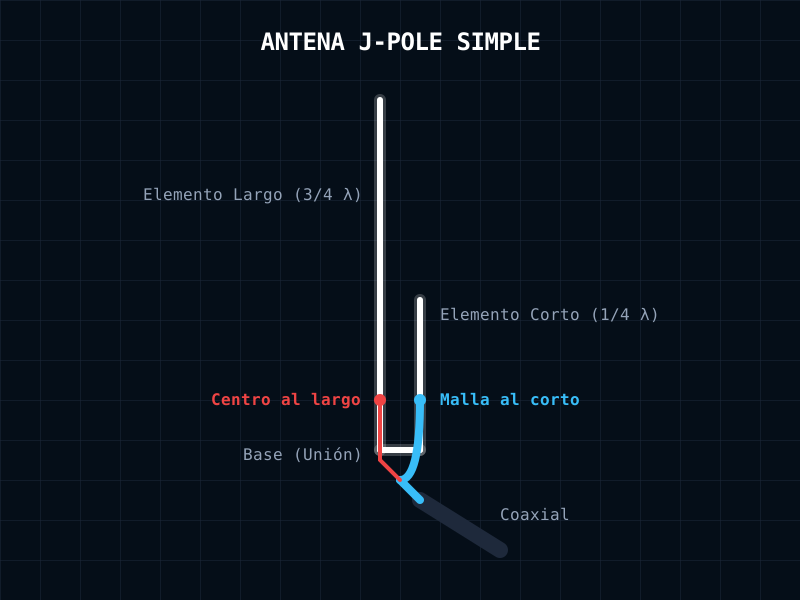
⛺ Emergency Deployment Guide (For Non-Techs)
- Setup: The J-Pole antenna must always be mounted completely vertically.
- Recommended Height: Place it as high as possible and clear of metal roofs or large concrete structures. Tying it to the highest branch of a tree with non-conductive rope (nylon/paracord) or putting it on a wood/PVC mast is ideal.
- Isolators and Spacing: Unlike the dipole, the J-Pole is extremely sensitive to nearby metals. If you mount it on a metal mast, make sure the mounting point is below the shortest tube (the bottom of the “J”). The rest of the antenna should not touch metal.
- Feed Line (Coaxial): 50-ohm cable is recommended (RG-58, LMR-400). If you don’t have any, you can improvise with 75-ohm TV cable (RG-6) for emergencies; if the antenna is cut correctly, the radio will accept it without being damaged.
Document prepared and approved by:
Pablo Rocchetta HP1PAR / LU2ECV
Revision V1.0
Do you have suggestions or corrections? Visit the Suggestions Box.
Pablo Rocchetta HP1PAR / LU2ECV
Revision V1.0
Do you have suggestions or corrections? Visit the Suggestions Box.