
When we connect an unbalanced coaxial cable to a balanced antenna (like a dipole), some of the radio frequency (RF) energy travels back toward the radio on the outside of the cable’s shield. This causes interference, distorts the antenna’s radiation pattern, and can cause RF burns when touching the equipment.
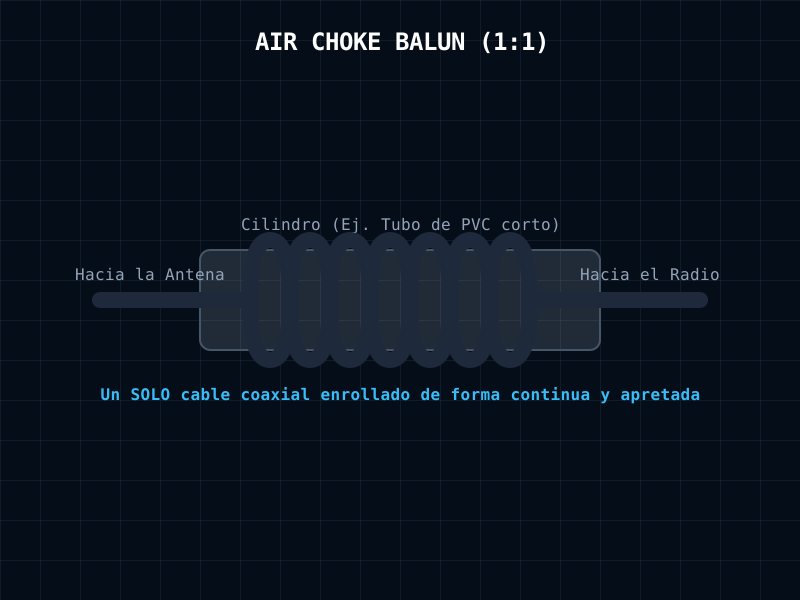
An Air Choke Balun (1:1) solves this by acting as a “choke.” By coiling the coaxial cable into a cylinder, we create an inductance coil that blocks the unwanted RF without affecting the internal signal.
Tactical Air Balun Calculator
Select or enter the operating frequency to get the recommended dimensions for the PVC pipe and the number of turns of RG-58 or RG-213 coaxial cable.
⛺ Emergency Construction Guide (For Non-Techs)
- Where is it placed? The choke or balun should be made as close as possible to the point where the cable connects to the antenna (less than 4 inches from the dipole center). Do not make it near the radio.
- How is it coiled? Take the coaxial cable and give it the indicated number of turns around the PVC pipe. The turns must be tightly packed against each other (together, leaving no gaps between the coils).
- Fastening: Once you coil the cable, secure it tightly with plastic zip ties or electrical tape so it doesn’t spring apart.
- Without PVC (UHF): For very high frequencies like UHF, the required diameter may be so small that you could simply coil the cable upon itself (3 small loops in the air) and tie it with a zip tie, without needing a pipe in the center.
Document prepared and approved by:
Pablo Rocchetta HP1PAR / LU2ECV
Revision V1.0
Do you have suggestions or corrections? Visit the Suggestions Box.
Pablo Rocchetta HP1PAR / LU2ECV
Revision V1.0
Do you have suggestions or corrections? Visit the Suggestions Box.