1. Beyond Purism: The Survival Imperative
Within the amateur radio community, there has historically been debate surrounding Citizens Band (CB at 27 MHz), at times underestimated due to its unlicensed, test-free nature.
However, during a major catastrophe (earthquakes, severe hurricanes, or wide-scale blackouts), the value of a communications network is not measured by the license class of the sender, but by the real-world ability to link a person in danger with someone capable of responding.
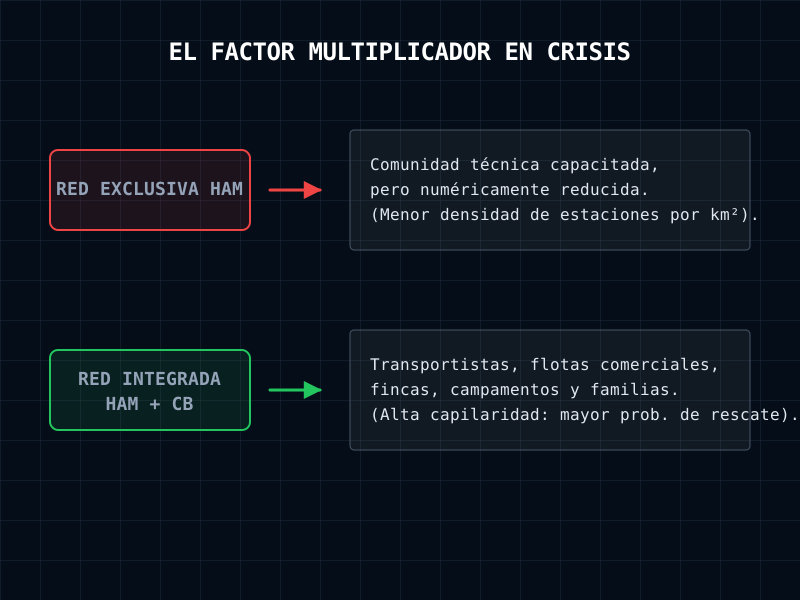
In a critical emergency, the core principle is straightforward: the greater the number of receivers monitoring the spectrum, the higher the probability that a distress call will be heard and relayed in time.
2. The Core Advantage: Accessible HF for the General Public
Most unlicensed individuals seeking backup comms turn to short-range handheld VHF/UHF radios (FRS/PMR walkie-talkies). While useful over short line-of-sight spans (1 to 3 km in urban zones), they are easily blocked by terrain, hills, dense forests, or heavy buildings.
Citizens Band operates at 27 MHz, positioned at the upper end of the HF (High Frequency) spectrum. This grants it unique physical characteristics absent in VHF/UHF:
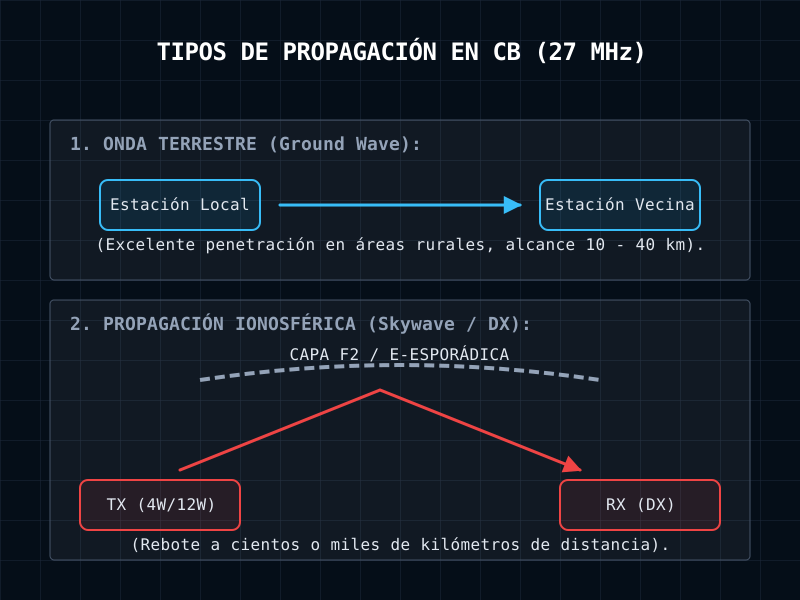
Using standard legal output (4W AM/FM and 12W PEP SSB), a base or mobile CB station with a tuned vertical covers 10 to 40 km over flat or interurban terrain, significantly outperforming handheld UHF radios.
During solar peaks or Sporadic-E events, 27 MHz waves reflect off the ionosphere across thousands of kilometers. An SSB call (Ch 16) can reach distant international operators during total local blackouts.
3. Directional Antennas & Wire Arrays at 27 MHz
The concept of directional wire dipoles and reflectors applies directly and practically to the 11-meter band:
- Compact & Cost-Effective Build: At 27 MHz, one full wavelength ($\lambda$) is approximately 11 meters. A half-wave dipole ($\lambda/2$) measures just ~5.30 meters total (two 2.65 m wire legs).
- Passive Reflector Wire: Adding a parallel reflector wire 5% longer underneath or behind the driven element creates a lightweight directional beam that focuses RF energy toward a priority sector (a valley, highway, or specific rescue checkpoint).
- Low-Cost Field Efficiency: When combined with portable 12V battery packs, simple wire antennas turn low-cost CB transceivers into resilient regional comms hubs.
4. Operational Emergency Guide for Citizens Band
To ensure efficient, disciplined operation between amateur operators and the general public, standard channel conventions must be observed:
| CHANNEL | FREQUENCY | PRIMARY MODE | TACTICAL EMERGENCY ROLE |
|---|---|---|---|
| Channel 9 | 27.065 MHz | AM | Official Emergency & Distress Channel: Strictly reserved for immediate distress calls, accidents, and life safety. |
| Channel 19 | 27.185 MHz | AM | Highway & Road Transit: Monitored by truckers and commercial freight; vital for real-time passability and roadside assistance. |
| Channel 16 | 27.155 MHz | USB / LSB / AM | Sideband (SSB) Calling Channel: Superior range with low power; optimal for medium and long-range tactical links. |
5. The Amateur Radio Operator as a Technical Bridge (Human Gateway)
Experienced amateur radio operators should not compete with Citizens Band, but rather serve as community bridges:
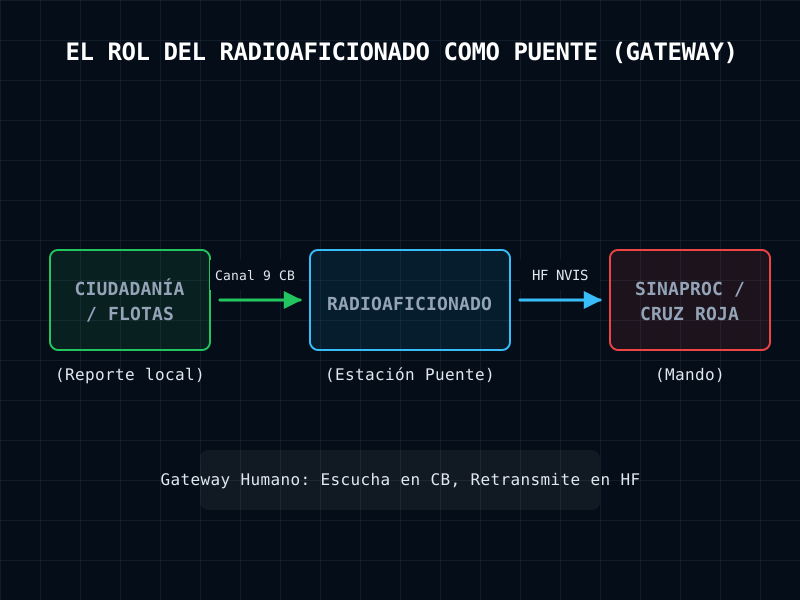
Keeping a secondary receiver or scanner tuned to CB Channel 9 during severe weather or declared emergencies.
Copying citizen calls, verifying coordinates, and injecting verified traffic into formal civil protection HF/VHF nets.
Helping neighbors construct resilient wire dipoles and tune SWR to maintain communications when cell networks drop.
6. Conclusion: Pragmatism and Community Resilience
Emergency communications are not about technical exclusivity, but about community resilience.
Citizens Band democratizes RF access, giving rural farms, motorists, coastal boaters, and families a dependable lifeline. Integrating CB into comprehensive emergency planning multiplies eyes on the ground and ensures that when modern infrastructure goes dark, no distress call goes unanswered.